Neurodegenerative Support in HSR Layout
Motor Neuron Disease Supportive Therapy in Bangalore
Motor Neuron Disease (MND) is a complicated neurodegenerative risk that requires comprehensive care to maintain autonomy and quality of life. The leading hospitals and special rehabilitation centres across Bangalore work together to personalize clinical strategies. Such services include speech therapy, non-invasive ventilation, physiotherapy, functional occupational support, and nutritional planning. ALS is the most common type of MND, and Clinic Living Plus in Bangalore works with all MND forms. CLP doesn't cure but delivers functional medicine supportive care. MND supportive therapy includes respiratory support, physical therapy, and speech and swallow therapy. CLP focuses on cellular nutrition, functional medicine, and lifestyle adjustments rather than offering a clinical disease-management program to control progressive neurological disorders, like MND.
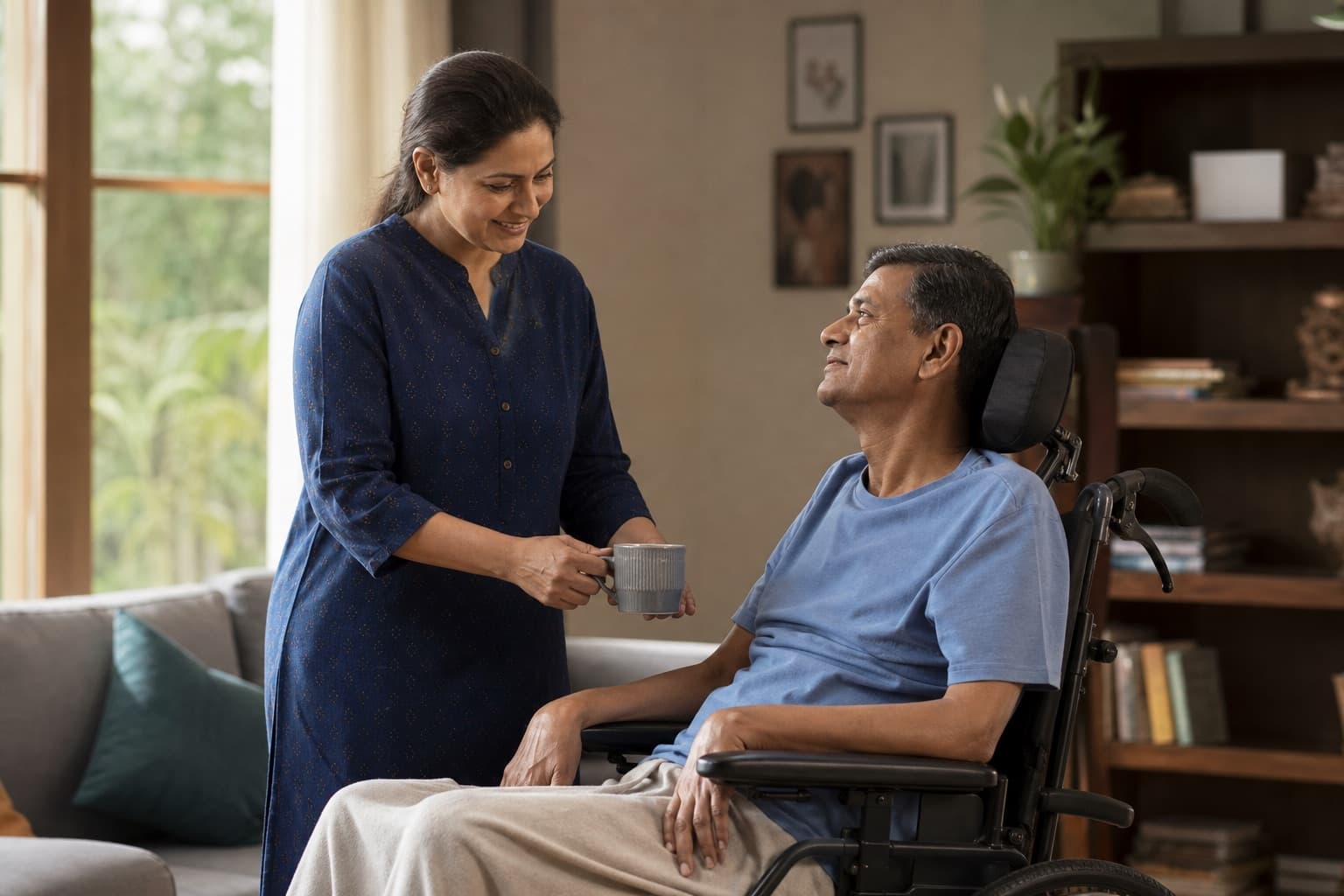
90% of MND diagnoses are ALS — CLP works with all MND form
Supportive care that is measurable, coordinated and reviewed — not a promise to cure.
90%
Share of MND cases that are ALS
8–12 wks
Laboratory review cycle to modify the protocol
7+
Disciplines coordinated across the MND care team
Terminology
MND vs ALS: Understanding the Terminology
People tend to use MND and ALS interchangeably; however, they have a distinguishing hierarchical relationship. MND is considered to be an umbrella term that describes a group of progressive neurological diseases that destroy motor neurons, the cells controlling vital movements, such as breathing, speaking, and walking. ALS, the most common type of MND, usually accounts for approximately 80% to 90% of diagnoses. The other rare variants exist in the form of Primary Lateral Sclerosis and Progressive Muscular Atrophy. Clinicians in North America commonly use ALS to mean overall MND, whereas Australia and the UK prefer MND as the key overarching category.
Here are the key points to understand the differences between MND and ALS:
- MND is the umbrella term for a group of progressive neurodegenerative diseases targeting motor neurons.
- ALS, the most common form of MND, around 90% of MND cases
- Primary Lateral Sclerosis (PLS), Progressive Muscular Atrophy (PMA), and Progressive Bulbar Palsy (PBP) are other types of MND
- The functional medicine protocols at CLP are implemented across all types of MND by sharing inflammatory, nutritional, and mitochondrial aspects.
Clinical Definition
What Supportive Therapy for MND Means Clinically
Supportive Therapy for MND clinically focuses on improving quality of life, maintaining everyday functionalities, and controlling symptoms as disease-modifying treatments are limited. It demands a well-coordinated multidisciplinary care team and maintaining respiratory functions via noninvasive ventilation. Mobility equipment and adaptive communication tools help patients to maintain autonomy and dignity. Supportive care mainly combines advanced care planning and psychological guidance that shift the clinical goals from curing the disease to optimising comfort as neurodegeneration advances.
Here are the key inclusions of supportive therapy for MND:
- Standard MDT supportive care includes dietetics, respiratory support, physiotherapy, neurology, and speech and language therapy
- Functional medicine supportive therapy includes gut health support, mitochondrial support, inflammation control, and nutritional optimization
- Complementary layers that don't replace the standard MDT
- Standard MND focuses on caloric sufficiency, and CLP goes further in nutrient optimization, supplement-based deficiency fix, and anti-inflammatory dietary modifications
- The therapy is not pharmaceutical and device-based but functional and nutritional intervention
The Programme
CLP's Functional Medicine Protocol for MND
Clinic Living Plus approaches complicated neurodegenerative disorders, like MND, via an all-inclusive functional medicine framework. CLP's personalized treatment plan usually combines IV nutrition therapy to bypass a poor digestive system, functional nutrition, and high-dose antioxidants. Plus, supportive modalities such as infrared saunas and oxygen therapy are used to boost mitochondrial energy production, cellular repair, and tissue oxygenation. Such an integrative strategy slows down disease progression, controls inflammation and boosts overall life quality.
Here are the inclusions of CLP's supportive therapy programme for MND patients:
- Personalized supplementation that is created from laboratory results but not a generic MND supplements protocol
- Comprehensive functional laboratory panel focused on gut microbiome, inflammation markers, micronutrients, and mitochondrial functionalities
- Dietary programme, anti-inflammatory food pattern, and caloric optimization that are adapted for dysphagia where relevant
- Ozone therapy (Major Autohemotherapy) offered as an additional supportive treatment module with IV nutritional therapy and supplementation that target neuroinflammation and boost cellular oxygenation
- Coordination with the neurology MDT where protocols are clear and shareable
- 8 to 12 week laboratory reviews to track markers and modify the protocol as the disease advances
Research
The Emerging Evidence in MND Supportive Research
The latest advancements in MND supportive research show a significant shift to patient-centric and multidimensional care strategies. Emerging evidence underscores the high importance of early multidisciplinary approaches, including special respiratory support, personalized nutritional management, and rehabilitation that demonstrate improvements in life quality and survival rates. As disease-modifying therapies keep evolving, improving supportive care offers renewed hope and more dignity for patients and their families experiencing such a challenging condition.
Here is what research shows about supportive interventions in MND:
- The nutritional decline in MND is well-documented, with muscle wasting and weight loss related to faster progression, where nutritional support is a care standard.
- Neuroinflammation in MND with elevated inflammatory markers repeatedly found, and anti-inflammatory interventions are under investigation.
- Studies have revealed distinguishing gut dysbiosis patterns in ALS/MND patients, with an emerging area of microbiome support.
- Mitochondrial functionalities are impaired in ALS motor neurons, and coenzyme Q10 and mitochondrial nutrients have been investigated in clinical setups.
- No single intervention has been proven in an RCT to personalize MND disease course; however, the evidence base to support functional interventions is growing
Coordination
How CLP Integrates with the MND Care Team
CLP seamlessly integrates with the MND Care Team by following a multidisciplinary and collaborative approach to patient support and symptom management. Our clinic fills gaps between traditional clinical neurology and alternative wellness by identifying MND's complicated and progressive aspects. With a unified network, CLP improves patient mobility, nutritional intake, and respiratory support, reducing fragmentation, relieving caregiver pressure, and improving overall life quality throughout the disease progression.
Here are the ways CLP works with the standard MND multidisciplinary team:
- The multidisciplinary team, including a neurologist, physiotherapist, therapist, SLT, dietician, palliative caregiver, and respiratory specialist, works together.
- CLP includes the functional medicine layer of inflammation, gut health, and nutrient optimization; the areas the MDT dietitian may not cover extensively
- CLP doesn't conflict with an MDT member, with all protocols being clear and coordinable.
- CLP adjusts protocol at every lab review and stays consistent with the MND's evolving nature
- CLP may communicate with the MDT or neurology team if the patient asks for shared reporting.
“In motor neuron disease, the question is not whether to seek supportive care — it is which aspects of supportive care are evidence-informed and which are not. CLP's functional medicine programme addresses the real, measurable gaps in MND nutrition and metabolic health.”
Frequently Asked Questions
What is supportive therapy for motor neuron disease?
Supportive therapy for MND involves all types of care not intended to cure the disease, such as nutrition, physiotherapy, functional medicine, respiratory support and speech therapy. At CLP, the functional medicine programme fixes the metabolic, inflammatory and nutritional elements of supportive care.
Why is MND Supportive Therapy Crucial?
As MND affects nerve cells controlling voluntary muscle movements, supportive therapy doesn't cure the disorder but controls symptom progression. It helps patients maintain mobility, swallow safely, communicate easily, and breathe comfortably for the longest time.
Is ALS the same as Motor Neuron Disease?
ALS is the most common type of Motor Neuron Disease that constitutes 90% of MND cases. The other types of MND cases include Progressive Muscular Atrophy and Primary Lateral Sclerosis. CLP works for patients with all types of MND.
Is there functional medicine treatment for motor neuron disease in Bangalore?
Yes, you can get functional medicine treatment for MND in Bangalore. CLP offers functional medicine supportive care to MDS/ALS patients that covers nutritional evaluation, regular monitoring, dietary planning, and targeted supplementation. It is complementary care with neurology MDT and not a standalone treatment.
What role does nutrition play in motor neuron disease?
Nutrition is clinically vital in treating MND. Muscle wasting and weight loss are related to faster progression. Taking enough protein, calories, and certain micronutrients is crucial to treat MND. CLP offers standard dietary support by increasing nutrients, fixing deficiencies and following an anti-inflammatory diet.
What role does physiotherapy play in managing MND symptoms?
Physiotherapy focuses on maintaining the existing muscle strength, preventing painful contractures and controlling spasticity. The physiotherapists design gentle range-of-motion routines, sub-maximal aerobic activities and stretching protocols without fatiguing the muscles. Assisted stretching and hydrotherapy(aqua therapy) are widely implemented in MNS supportive therapy.
Can anti-inflammatory interventions help with MND?
Neuroinflammation is a key feature of ALS/MND. Supplement interventions are under investigation. No evidence shows they change the disease course; however, they are evidence-informed supportive measures and mainly for wholesome metabolic health.
Does CLP work with MND neurology teams in Bangalore?
Yes, CLP does work with MND neurology teams in Bangalore. The protocols are created to be clear and shareable with the neurology/MDT team. CLP doesn't advise stopping/modifying all neurological medicines. The neurologist reviews all supplement protocols.
What tests does CLP run for motor neuron disease patients?
CLP performs a functional medicine panel that usually includes micronutrient levels (B12, zinc, omega-3, and magnesium), and inflammatory markers (homocysteine, CRP, and IL-6 where shown), metabolic markers, mitochondrial function markers, and gut health assessment. The protocols aren't preset but designed from results.
Is functional medicine for MND supported by evidence?
Functional medicine for MND isn't supported by evidence to cure, reverse, or slow the disease progression. The individual components, such as gut microbiome intervention, mitochondrial support, anti-inflammatory and nutritional optimization, have an evidence base in neurodegeneration research. ALS-centred RCT hasn't been proven in an ALS-centred RCT to control disease progression. CLP offers supportive care and doesn't modify disease.
Schedule Your Consultation
Book a Consultation Today
Prefer to talk now
Are you looking for a good motor neuron disease supportive therapy in Bangalore? CLP plays the role of a functional medicine layer and the MND MDT. Book a consultation at our clinic today. Our first consultation includes laboratory assessment, MDT coordination, and protocol discussion.
Call Us
+91 72931 11120info@Cliniclivingplus
Location
HSR Layout, Bengaluru, Karnataka 560102
Hours
Mon-Sun: 9:00 AM - 7:00 PM